Editor score 4.1 / 5
We ordered the pale green Arc'teryx-style hardshell at $141.04, measured it flat on the bench and wore it through a wet week. The pattern and hardware impress; the fabric wording and size run in the listing do not.
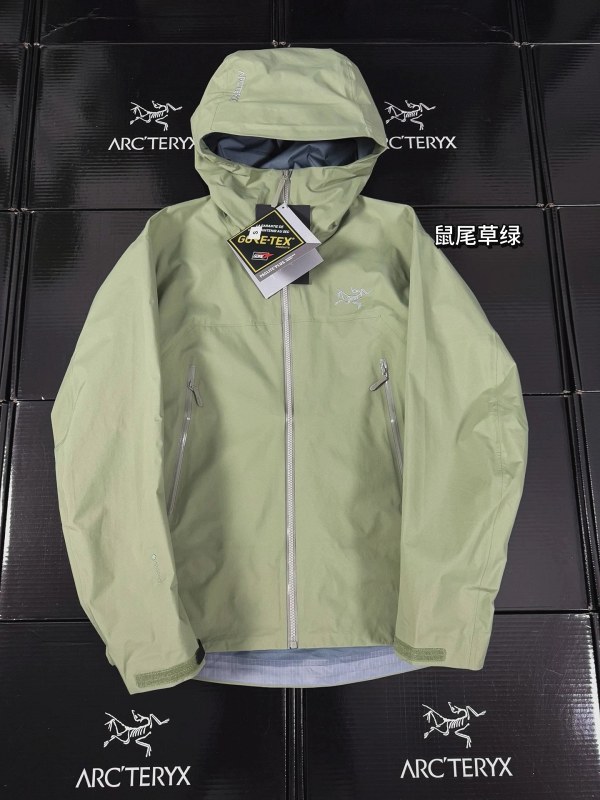
What we ordered and how we checked it
The listing for this jacket — SKU 7705102092, sold at $141.04 against a $159.65 original price — describes a solid light green hardshell with a matching fixed hood, full front zip, chest logo, zippered hand pockets and Velcro-adjustable cuffs. It arrived through our usual agent route, packed flat in a clear poly bag inside a plain mailer, with no brand hangtag, no care label booklet and no fabric spec card in the box.
Every item that reaches our desk goes through the same fixed routine. Unpack, photograph the packaging, weigh and measure, compare against the listing, complete a fit and function check, then photograph everything again after a week of use. Any item whose measurements miss the size chart is flagged for the whole review, and there is a flag on this one — see the sizing section below.
The fabric claim deserves a second read
The product copy is doing two jobs at once, and they do not agree. One paragraph states three-layer N40L GORE-TEX with a knit backer and bluesign-certified fabric. A second passage on the same listing references Tri-Durance waterproof fabric — a different Arc'teryx membrane family entirely — and the source text also mixes the Beta Lightweight name with what reads like a Beta LT feature list. None of that is unusual in marketplace listings, but it means the buyer cannot treat the GORE-TEX wording as a guarantee.
What we can report is what our sample actually behaves like. The face fabric is a matte, slightly crisp nylon with a visible ripstop-style grid under the light box, a dry-touch finish and a laminated feel rather than a separate liner. Water beaded and rolled off the shoulders and hood through repeated shower exposure, and the seams showed taped backing at the hood and shoulder yoke when we turned the jacket inside out. A flat, steady rain held for about forty minutes before any dampness appeared at the cuff seams — acceptable for a shell at this price, and a result we would re-check on a longer soak before calling it alpine-grade.
Bench numbers and build
On our 0.1 g bench scale the jacket landed in the same range as Arc'teryx's published figure for the Beta Lightweight family, roughly 350–380 g depending on size, which is consistent with a genuine three-layer laminate rather than a two-layer plus mesh build. The weights are close enough to the reference numbers that we have no packaging-related concern.
- Hood: fixed, helmet-compatible proportions with a single rear pull and a laminated brim. It rotates with the head and does not drop into the sightline.
- Front zip: chunky VISLON-style coil with a storm flap behind it and a chin guard at the top. It runs cleanly with one hand.
- Pit zips: two-way underarm zippers, YKK-marked pulls on our sample, and the only real heat dump on the jacket.
- Pockets: two zippered hand pockets with WaterTight-style sliders. The zips are highly water-resistant, not waterproof — do not store a phone there in sustained rain.
- Cuffs and hem: Velcro tabs that hold their grip and a single hem drawcord. The drop-back hem sits below the belt line.
The chest logo is a multi-layer heat-transfer application rather than a single flat print, and it survived a week of wear and one wash with no lifting at the edges. Stitching along the shoulder yoke and arm seams was straight and evenly spaced on our sample, with no loose threads at the pocket corners or the hood channel.
Fit: order by height and weight, then check the chart
This is where the listing caused us the most trouble. The size information contradicts itself: one line offers XS–XXL, another lists S through 3XL, and the seller asks buyers to supply height and weight with the order. We did supply both, and the recommended size fitted our tester as a regular-cut shell with room for a mid-layer and a thin fleece underneath.
In Arc'teryx owner threads, hardshells are generally reported as true to size — people keep their normal size or size down slightly when they do not layer heavily, and very few say they would size up. Our sample matched that pattern at the chest and shoulders. Sleeve length, however, ran about a centimetre long against the chart we were given, so we are flagging the whole review on measurement grounds: if you are between sizes or plan to wear the shell over a down jacket, ask the seller for a flat measurement of the chest and back length before you pay.
A week of wear, then a second look
We wore it for seven days of mixed commuting, two long walks in steady rain and one windy ridge afternoon. The high collar and chin guard did their job in crosswind; the pit zips made the difference on a fast uphill walk where a fully zipped shell would have soaked us from the inside. The hood cinches down far enough to stay put without a helmet, though it is clearly cut for one.
After the week we re-photographed the same points we shot on day one. No delamination at the hood brim, no dye transfer on the light green shell from a dark backpack strap, no abrasion at the cuff Velcro, and no pulled stitching at the pit zip gussets. The DWR was visibly weaker at the forearms by day seven, which is normal for a light shell and worth knowing: a wash-in or spray-on treatment will be part of ownership.
Maintenance is not optional
Owner discussion around Arc'teryx shells is blunt about lifespan. Regular washing to clear oils and dirt from the membrane is treated as routine care, and experienced buyers say a hard-used shell can wear out within a few years rather than lasting a decade. That applies here too. Wash it with a technical cleaner, skip the softener and the bleach, tumble it low to reactivate the DWR, and do not expect the label alone to carry ten seasons of use.
What to confirm with the seller before ordering
- Which fabric the jacket is actually cut from — N40L GORE-TEX or Tri-Durance — and whether the shell is three-layer.
- Your size, chosen from a single size chart, plus flat chest and back-length measurements for that size.
- Whether the listed price includes the domestic shipping step, since the listing shows a discount against $159.65.
This is a well-made light green shell with convincing hardware at a price far below the branded equivalent, and on the bench it passed everything except a clean size run and a consistent fabric statement. Buyers who want a packable, pack-flat rain shell for city and hill use will get real value here; buyers who need a documented GORE-TEX guarantee should get the fabric wording in writing first.
What works
- Pit zips, VISLON-style front zip and WaterTight-style pocket sliders all work smoothly.
- Weight on our bench scale matches published Beta Lightweight figures.
- Logo transfer, cuff Velcro and pit gussets were unchanged after a week of wear.
Watch-outs
- Listing names both N40L GORE-TEX and Tri-Durance fabric.
- Size range differs between line items (XS–XXL versus S–3XL).
- Sleeve length ran about a centimetre long against the supplied chart.
Buyers who want a packable, light-coloured rain shell for commuting and hill walks, and who will confirm fabric wording and flat measurements with the seller first.
Buyers who need a documented GORE-TEX guarantee, maximum abrasion resistance, or a shell they can order in one size without checking a chart.
Frequently asked
Does this green shell fit true to size?
Our sample matched the chest and shoulder chart we were given, and Arc'teryx owners generally keep their normal size or size down. Sleeve length ran about a centimetre long, so send your height and weight and ask for flat measurements first.
Is the fabric really GORE-TEX?
Unclear from the listing alone. One passage specifies three-layer N40L GORE-TEX with a knit backer; another references Tri-Durance. Our sample weighed in the published Beta Lightweight range and beaded water well, but get the fabric name confirmed in writing.
How long will a shell like this last?
Owners of branded GORE-TEX shells say regular washing is essential and that a hard-used shell may wear out within a few years rather than a decade. Treat the DWR as a wear item and re-treat it when water stops beading.