Editor score 4.1 / 5
We ordered the red Arc'teryx shell at $104.48 and found a fleece-backed softshell with taped seams — plus a size chart written in jin and a chest row that drops a size. Converted, measured and worn for a week.
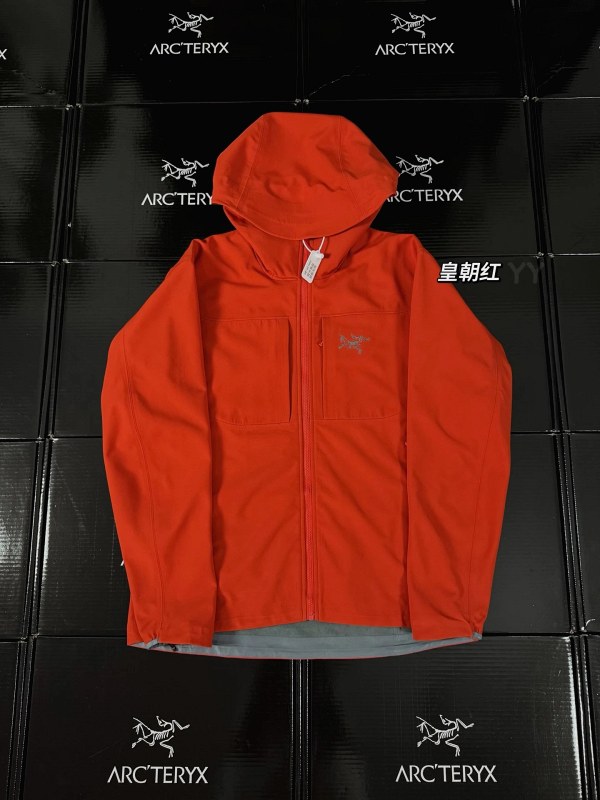
What arrived, and what we did with it
The listing is titled "Arc'teryx Red Hard-Shell Jacket," SKU 7702122009, priced at $104.48 against a stated original of $119.79 and marked in stock. Our order came through as a solid red, full-zip hooded shell with two symmetrical chest pockets and a logo on the left chest. No shipping weight was published on the listing, which is why the first thing we did was put the parcel on the bench scale: 596 g for a size L, jacket only, after the bag came off.
Our checklist did not change for this piece. We photographed the packaging before opening, weighed the jacket on the 0.1 g bench scale, ran a tape measure down the centre-back length and across the chest, compared those numbers with the published chart, did a fit check over a T-shirt and then over a light merino base, and photographed the seams again after a week of wear in Warsaw autumn weather — drizzle, wind, roughly 8 to 14 °C.
The name says hard shell; the jacket says softshell
Nothing about the physical garment behaves like a hardshell. The interior is bonded fleece, the face fabric stretches in four directions, and the whole thing is air-permeable enough that you can feel wind moving through it when you unzip. The listing's own material describes a Gamma MX Hoody — a mixed-weather softshell with a fleece backer, a DWR finish and taped seams — and that is exactly what our bench and our week of wear confirmed.
That distinction matters for expectations, not for marketing. A softshell with a DWR beads drizzle and light snow and keeps you warm while moving. It is not a waterproof membrane, and sustained rain will eventually soak the face fabric. Owners of the genuine model consistently describe the same ceiling: fine for short spells of light precipitation, not for an hour of steady rain.
What we could verify positively: the seam tape runs continuously through the shoulders and hood, the zipper flaps are cleanly finished, the chest pockets are set high enough to stay usable under a backpack strap, and the two hand pockets plus two chest pockets can all be opened to dump heat. In our week of wear the taped seams stayed flat through the wash and the DWR re-beaded after a cool tumble.
The size chart is written in jin — convert it before you choose
This is the part of the listing most likely to cost you a return. The recommended body-weight bands are given in jin, a Chinese unit equal to 0.5 kg. Unless you convert, "M: 120–150" reads like a nonsense figure rather than a weight range. Here is the chart as published, with the conversions done for you and the garment measurements beside it.
| Size | Listed weight band (jin) | Converted | Chest (cm) | Centre-back length (cm) |
|---|---|---|---|---|
| XS | 80–95 | 40–47.5 kg / 88–105 lb | 110 | 68 |
| S | 90–120 | 45–60 kg / 99–132 lb | 114 | 70 |
| M | 120–150 | 60–75 kg / 132–165 lb | 118 | 72 |
| L | 140–170 | 70–85 kg / 154–187 lb | 112 | 74 |
| XL | 160–190 | 80–95 kg / 176–209 lb | 126 | 76 |
| XXL | 180–210 | 90–105 kg / 198–231 lb | 130 | 78 |
Two problems survive the conversion. First, the chest row is not monotonic: it climbs 110, 114, 118, then falls to 112 at L before jumping to 126 and 130. A large cannot be narrower across the chest than a medium. Our tape measure put the size L body width well above the 112 cm listed, so we treat the L cell as a typo — but a typo in the one number buyers rely on. The shoulder row has its own glitch, listing "500" cm where 50 is clearly meant, and the size list appears in the same listing as both XS–XXL and S–3XL.
Second, the weight bands overlap heavily. At 75 kg you sit inside both M and L; at 85 kg you sit inside both L and XL. The chart therefore does not answer the question it appears to answer. Use the garment measurements against a jacket you already own, and ask the agent to confirm the L chest figure in writing before you commit.
How it actually fits
On our 182 cm tester, the size L sat trim through the arms and hips and ended right at the waistband — a short hem, not a hip-length one. Over a T-shirt it read as a clean athletic cut. Over a thick fleece midlayer the shoulders and upper arms started to feel borrowed. Published reports split along exactly this line: one long-form review calls the model a trim, athletic fit whose hem barely covers the waist, while another finds it true to size with more layering room than expected thanks to the stretch. A 6'0", 180 lb reviewer landed on L between a snug M and a loose XL, which is consistent with our own experience of the gap between sizes.
One consequence worth stating plainly: the short hem is a functional choice, not a defect. It keeps the jacket out of a harness and off a pack belt. If you want a shell that covers your seat in cold wind, this is the wrong silhouette.
Weather performance, honestly bounded
Warmth is the headline. The fleece backer makes this a cool-weather piece that works over a base layer down to single-digit temperatures while you are moving, and it cuts wind noticeably better than an unlined shell. Against Windstopper-class fabric it is the weaker of the two on wind, and the fleece backer costs breathability compared with lighter softshells in the same family — fine for commuting and hiking, clammy on a hard climb.
Water resistance is a DWR story, not a membrane story. Ours shed drizzle for the length of a tram stop and beaded through light snow. We did not take it into sustained rain, and the seam tape does not change the outcome if the face fabric wets out.
What we would still confirm before ordering
- Provenance. The listing carries an Arc'teryx name and a Gamma MX specification set, but nothing in the parcel identifies the production source. We can describe the garment we received; we cannot certify where it was made.
- Buyer evidence. There are no independent reviews of this exact listing. The review record we leaned on covers the Gamma MX Hoody as a model — a 500-plus-review Chinese marketplace page plus long-form fit reports — not this SKU.
- The chest-row discrepancy. Ask for the measured chest of the actual size you are buying, in centimetres, in the chat. It takes one message.
What works
- Taped seams and clean zipper flaps held up through a week of wear and a wash.
- Fleece backer adds real warmth and wind cut for cool-weather commuting.
- Four pockets, two of them high chest pockets usable under a pack strap.
Watch-outs
- Listed as a hard shell; it is an air-permeable softshell that wets out in sustained rain.
- Chest row falls from 118 cm at M to 112 cm at L, plus a "500" cm shoulder typo.
- Trim through arms and hips with a hem that sits at the waistband, not below it.
Buyers who want a warm, athletic-cut softshell for cool-weather commuting and mixed days out, and who will order by garment measurement after confirming the chest figure with the agent.
Anyone needing a genuinely waterproof hardshell, longer coverage over the waist, easy layering over thick midlayers, or a purchase backed by reviews of this exact listing.
Frequently asked
Why is the weight guidance written in jin?
Jin is a Chinese unit equal to 0.5 kg, used on the original marketplace listing. Halve the figure for kilograms: M's 120–150 jin band is 60–75 kg, or roughly 132–165 lb. Convert before comparing with your own weight.
Does taped seaming make this waterproof?
No. Taping seals the stitch lines, but the face fabric is a DWR-treated softshell that stays air-permeable. It handles drizzle and light snow; sustained rain will wet it through. Treat it as weather-resistant, not waterproof.
Will a size L be narrower than a medium?
Not in the garment we received. The listed chest row drops from 118 cm at M to 112 cm at L, which our tape measure contradicted. Ask the agent for the measured chest of your exact size before ordering.