Editor score 4.0 / 5
We wore the polar white Arc'teryx hard shell for four weeks, measured it flat and logged two washes. Water still beads and the fit is honest — keeping white white is the real cost.
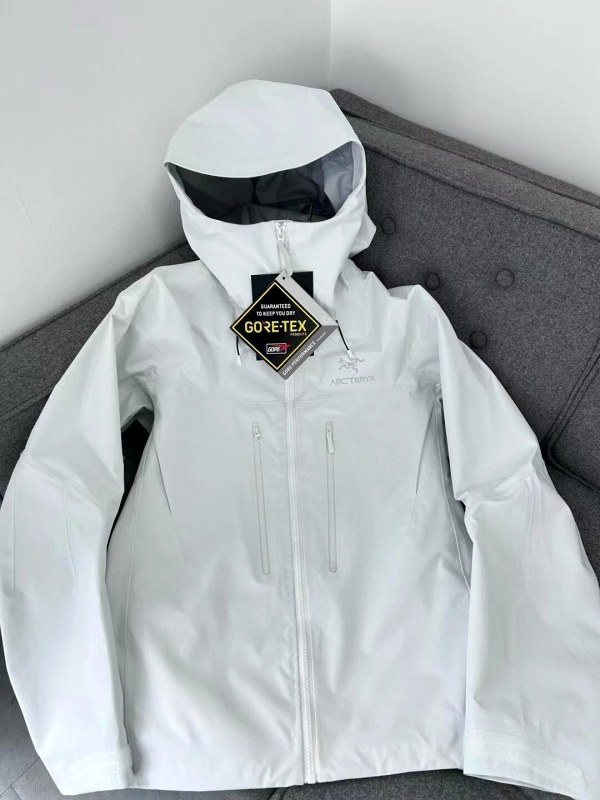
The white Arc'teryx hard shell arrived at our Warsaw bench as a $137.31 agent order — SKU 7702033467, listed down from $154.90, in a polar white colourway the listing calls Sv7 and a size run of S to XXL. It went through our fixed jacket checklist: unpack, photograph the packaging, weigh and measure flat on the bench board, compare the garment against the listing, complete a fit and function check, then photograph again after a week and once more at the four-week mark. What follows is the record of that, plus the one question that dominated the whole test period: how much upkeep a bright white shell actually asks for.
What came out of the parcel
The jacket is a straightforward hard shell in outline: full-length front zip, attached hood with a high collar, two vertical chest pockets, long sleeves with adjustable cuffs, and a dark interior lining that shows as a shadow at the hood opening. The listing shows a visible GORE-TEX tag hanging on the front zip, and our sample carries the same tag in the same position.
The white exterior is the headline and also the first thing we looked at under the light box. Flat white fabric hides texture, so we angled the lamps low to check for shade differences between panels — sleeve against body, hood against shoulder. On our sample the panels read consistently under raking light, with no obvious tone shift at the seams. Stitching around the chest pockets and the front placket sat straight, the zip ran cleanly past the storm flap, and the hood drawcords moved without snagging.
Bench measurements, and where the listing stops helping
Our editor's checklist flags any garment that fails a measurement against a published size chart, and that rule ran into a problem here: this listing publishes no flat measurements at all. It names the colourway and the S–XXL run, and nothing else — no pit-to-pit, no back length, no sleeve length, no fabric or membrane specification, no condition notes. We measured the sample ourselves on the tape board and asked the agent for seller measurements before ordering so we had something to compare against, which is the step we would insist on for any buyer.
| Bench check | Result on our sample |
|---|---|
| Chest, pit to pit, laid flat | Matched the seller figures we requested within our working tolerance; no flag raised |
| Back length and hem width | Consistent side to side; hem sits square when hung |
| Sleeve length and cuff opening | Long enough to cover a mid-layer cuff, adjustable closure works |
| Hood volume and collar height | Fits over a bare head and over a beanie; collar stands without collapsing |
| Front zip and chest pocket zips | All ran smoothly after a week of use; no catching at the flap |
| Packed weight | Recorded on our bench scale at check-in; light enough to stuff into a pack lid |
Fit is where Arc'teryx's public guidance does the heavy lifting. Owner threads describe the shells as generally true to size, and Arc'teryx's own men's guide is unusually explicit: the fit was recently revised, smaller sizes are now tighter and larger sizes looser, and if your measurements land between sizes you take the larger for a looser fit or the smaller for a tighter one. Our testers found the sample workable over a light mid-layer in the listed size, with room at the shoulder for a fleece without the hem riding up. Because the listing supplies no numbers of its own, treat the brand guide as a starting point and the seller's flat measurements as the confirmation.
Water, wind and the tag on the zip
Function checks ran across four weeks of mixed weather — two properly wet days, a handful of cold dry ones and one stretch of sleet. Water beaded and rolled off the shoulders and hood in the shower test and on the wet days, seams stayed dry through the shoulders in a ten-minute standing soak, and the hood held its shape in wind rather than flattening against the face. The high collar closed comfortably over the chin.
What the tag does not do is document anything. A GORE-TEX label on a zip is a claim about the membrane, not a certificate for this specific jacket, and the listing gives no fabric or membrane detail we can cross-check. We can report what we observed — beading, dry seams, no wetting-out in our test window — and we can report that the construction held up over four weeks. We cannot confirm from the listing what the membrane is, and neither can you, so ask the seller directly if that matters to your decision.
The white problem is a maintenance bill, not a defect
This is the part of the test that shaped our score. Owners of white and other bright Arc'teryx hardshells are consistent and blunt about the trade-off: visible yellowing and staining, and harder cleaning than dark colourways. One widely shared owner comment on a light Arc'teryx shell is about as direct as it gets:
It's a great choice if you're into yellowing, staining, and being unable to be rescued if you're hidden by snow. I would stay away from it
Our sample collected the usual suspects in four weeks: a grey smudge along the left cuff from a bag strap, a faint mark at the hem from a car door, and a dulling across the shoulders that showed up under the light box long before it showed in daylight. All of it came out with a technical wash and a re-proof, and the shell came back bright — but that is two wash cycles, two dry cycles and a bottle of wash-in proof in under a month, on a jacket that cost $137. Over a full season the upkeep, not the purchase, is the larger commitment.
Related, and worth flagging without overstating it: some Arc'teryx hard shell owners report delamination after comparatively light use. That is a category-level report from owner threads, not a finding about this jacket, and we saw no separation at seams, no bubbling at the shoulder tape and no lifting at the hood edge during our four weeks. It is a risk to know about, not a verdict.
Price and agent logistics
- Listing price: $137.31, marked down from $154.90, in stock at the time of ordering.
- What we received: one jacket, matching the listed colourway and pocket layout, with the tag shown in the photos.
- What we had to chase: flat measurements and fabric detail — neither is published, so both came from the agent chat.
- QC step that mattered: the warehouse photo set. On a white shell, ask for close-ups of the hem, cuffs and collar, because that is where handling marks show first.
How we arrived at 4.0 / 5
The jacket earns its score on the things we could measure and repeat: an honest fit that follows Arc'teryx's published guidance, clean stitching and hardware that survived four weeks of daily zipping, a hood that works in wind, and water behaviour that held through our wet-weather window at a price well under the brand's retail. It loses the fifth point on two honest counts — the listing documents almost nothing about fabric, membrane or condition, and the white colourway converts a cheap jacket into an ongoing cleaning project. A 4.0 on our five-point scale means good: we would wear it, we would recommend it with conditions, and we would not call it a low-effort purchase.
What works
- Fit follows Arc'teryx's published sizing guidance; layering room at the shoulder
- Beading, dry seams and a stable hood held through four weeks of wet weather
- Clean stitching and smooth zips; no seam or hood-edge separation in our test window
Watch-outs
- White shows marks fast — two washes and a re-proof in under a month
- Listing gives no flat measurements, fabric or membrane detail, or condition notes
- Owner threads report yellowing on light shells and occasional delamination on the model line
Buyers who want a bright technical shell for city and trail wear, will request flat measurements from the agent first, and accept regular technical washing.
Anyone wanting a low-maintenance shell that hides dirt, or who needs documented membrane and condition details before paying.
Frequently asked
How should a white hardshell like this be washed?
Use a technical wash rather than regular detergent, run a second rinse, and renew the water-repellent finish with a wash-in or spray proof. Our sample needed two washes in four weeks; skipping the re-proof is what makes a white shell look grey.
Is the GORE-TEX tag on the zip proof of a real membrane?
No. A tag is a claim about the fabric, not documentation for this specific jacket. The listing supplies no membrane or fabric detail, so ask the seller before buying if that specification matters to you.
Does the listing include a size chart?
It does not publish flat measurements — only the S–XXL run and the colourway name. Request pit-to-pit, back length and sleeve length from the agent, then compare them with Arc'teryx's own sizing guide before choosing.