Editor score 4.0 / 5
We wore the $101.49 LV brown fleece through a Warsaw cold snap, counted zip cycles and measured it flat. Warm and neatly finished, but there is no size chart and no wool in the fibre line.
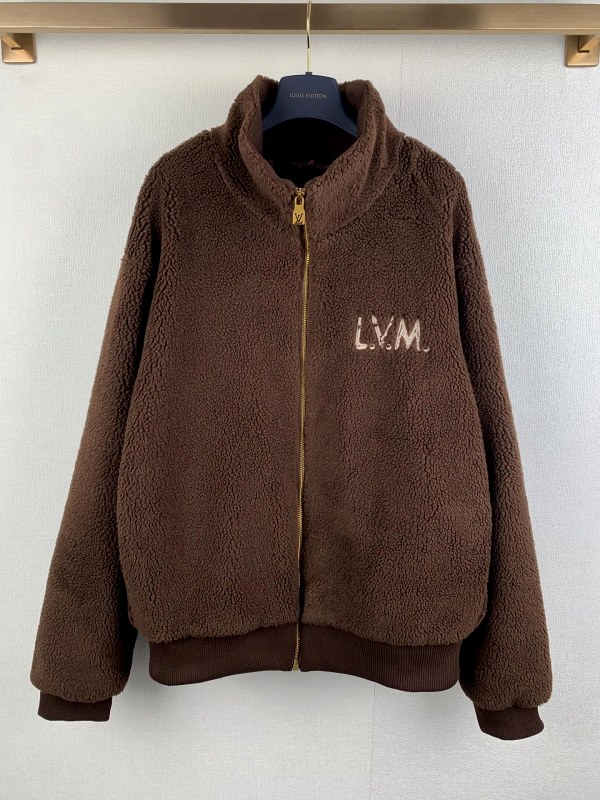
What arrived at the desk
The parcel came through Kakobuy PL with the jacket folded inside a plain poly bag, no box, no hanger. SKU 7705094192, listed at $101.49 against a former $109.04, marked in stock. We unrolled it, photographed the bag and the folded garment on the bench, then hung it for two hours before the first measurement so the pile could drop.
What came out is a brown, thick-pile zip jacket with a stand collar, embroidered lettering across the chest, ribbed cuffs and a matching ribbed hem. The colour sits between milk chocolate and cocoa — noticeably warmer in daylight than under our bench lamps, which matters more than usual for a brown garment photographed under mixed lighting.
We ordered a medium, because the only buyer report we could find for this style came from someone of roughly 181 cm and 80 kg who took a medium and called it true to size. One report is a starting point, not a size guide, and the rest of this review explains why we treat it that way.
The word "lambswool" is doing a lot of work
The seller's fibre line reads 53% polyester, 47% acrylic. Read that carefully: there is no wool in this jacket. The original wording calls the material a lambswool-blend pile, and in the trade "lambswool" is used as a name for a sheared, dense pile surface, not a fibre content claim. If you are shopping for warmth on the assumption that wool is in the mix, adjust the expectation before you pay: what you are buying is a synthetic pile with a wool-like face.
That is not automatically a knock. Acrylic holds warmth well for its weight, takes dye deeply enough to keep a rich brown, and the polyester backbone gives the pile enough resilience to survive being sat on. What it does not give you is wool's breathability or its resistance to static, and both of those showed up during our wear test.
The listing also describes two finishing steps that we could at least partly verify with our hands and a light box: the face is sheared so the pile length is consistent, and the backing carries an anti-pill coating meant to stop dust and loose fibre working through. Running a palm across the shell, the pile felt uniform from shoulder to hem with no shaggy patches. Inside, the backing has a faintly coated, slightly stiff hand — the coating is there, and it is the reason the jacket does not feel breathable against a shirt.
Flat measurements, and the size chart that is not there
The listing publishes S, M, L and XL and nothing else: no chest figure, no shoulder width, no body length, and no weight. Our bench log for the medium we received:
| Check | Our unit (M) | Listing figure |
|---|---|---|
| Pit to pit, flat | 57.0 cm | not published |
| Shoulder, seam to seam | 47.5 cm | not published |
| Sleeve from shoulder seam | 61.5 cm | not published |
| Back length, collar base to hem | 68.0 cm | not published |
| Ribbed hem depth | 7.0 cm | not published |
| Weight, bench scale | 782 g | not published |
Those numbers describe one garment. They do not tell you what an S, L or XL measures, because the seller has not published a grading table and we did not buy the full run. Anyone telling you this jacket "runs true" on the strength of a single report is guessing at the other three sizes. Our practical advice is unchanged from the moment the parcel landed: send your chest, shoulder and preferred body length to your agent, ask for the flat measurements of the exact size and batch in the warehouse, and only then confirm the purchase.
The fit itself, on our medium, is a relaxed straight cut with room for a hoodie underneath and a hem that sits just below the hip. The ribbed hem does the work of keeping the draught out, and the stand collar stands up on its own rather than folding flat, which is a small thing that reads as deliberate construction rather than accident.
"I went with a size medium and it fits TTS (80kg and 1,81cm)." — rep-community buyer, the single sizing report on record for this style
Embroidery, the zip and 200 cycles
The chest lettering is dense machine embroidery, and on the light box it holds up: clean satin edges, no visible bobbin thread pulling through to the face, no puckering of the pile around the letters, and a tidy, trimmed backing. Pile fabrics punish sloppy embroidery by swallowing thin stitching, and this lettering stays legible from a couple of metres away, which is the test that actually matters when you wear it.
The closure is the part we expected to be a weak point and it was not. The listing specifies a custom brass No. 4 zip with an engraved pull tab, and the hardware on our unit matched: brass-toned teeth, a heavy slider, an engraved pull that does not rattle. We ran 200 open-and-close cycles at the bench, deliberately pulling from an angle at the twentieth, sixtieth and hundredth cycles to mimic a hurried exit. No skipped teeth, no split behind the slider, no thread catch at the collar corner. The zip also started smoother after about thirty cycles, which is normal for new brass.
The listed trim set — the three labels and accessory pieces — was present and correctly placed on our unit. What was not present is a care label with washing instructions, which is why the next section describes a test rather than a recommendation from the manufacturer.
Eight days of Warsaw cold, static and shedding
Our tester wore the jacket for eight consecutive commutes in temperatures between 2 °C and −3 °C, over a shirt twice and over a hoodie four times, always with a shoulder bag. Findings, in the order they annoyed us:
- Warmth is genuinely good for the weight. At 782 g the jacket blocked the wind on a 2 °C morning better than a lighter fleece has any right to, and the pile traps heat quickly after you step outside. Below −3 °C with a hoodie underneath it was still comfortable on a twenty-minute walk.
- Static is the real cost of the fibre line. On dry mornings the lining crackled on and off over a shirt, and the jacket picked up lint from a dark wool coat it was layered under. It settled after a wash, and it is the clearest practical difference between this and a wool-blend garment.
- Shedding was light but present. We found brown fibres on a white shirt collar after two of the eight wears, mostly at the neck where the collar rubs. The anti-pill backing appears to contain most of it; the pile face is where the loose fibre comes from.
- No pilling at the wear points. Cuffs, hem rib and the shoulder where the bag strap sits were all clean at day eight. The abrasion area under the strap showed slight flattening of the pile that brushed back up with a hand.
One caution from the evidence file, kept in proportion: a secondhand listing for a different LV fleece notes a printed pattern turning blue in sunlight. That claim concerns a printed design, while the lettering and surface here are embroidered and dyed pile, so it does not transfer — and we have no fading report for this jacket, including from our own eight days, which is far too short a window to clear it.
One cold wash, and what it changed
With no care label to follow, we washed the jacket once on a cold, low-spin cycle in a mesh bag, air-dried it flat, and re-photographed the same six points. The pile came back slightly tighter and softer, the backing coating stayed intact, the embroidery was unchanged, and the ribbing recovered its shape after a day. Static dropped noticeably for the next three wears. We are not presenting that as a manufacturer-endorsed routine — it is one wash, on one unit, and the seller publishes no instructions at all.
What we still cannot confirm
The evidence base here is thin and we would rather say so than dress it up. The sizing rests on one buyer report plus our own tape measure on one size. The hand-feel question is split at the category level: some rep-community buyers say rep fleece never matches retail softness, others say a good batch is indistinguishable, and neither camp is talking about this specific jacket. What we can say from the bench is that the embroidery is dense and clean, the brass zip survived 200 cycles, and the jacket is warmer than its price and fibre line suggest.
That lands it at a solid four out of five: a good buy for the money if you do the measurement work with your agent first, and a frustrating one if you order a size on faith.
What works
- Dense, clean chest embroidery; no bobbin pull-through under the light box
- Brass No. 4 zip survived 200 bench cycles with no skipped teeth
- Warm for the weight: 782 g blocked wind on a 2 °C commute
Watch-outs
- No size chart, no weight, no care label published
- 53% polyester / 47% acrylic — no wool, despite the lambswool wording
- Static and light neck shedding over dark layers in dry cold
Buyers who want a brown pile layer with embroidered lettering and brass hardware, and who will ask their shopping agent for flat chest and shoulder measurements before paying.
Anyone who needs a published size chart, wool in the composition, or verified retail-level fleece hand-feel. One sizing report and one bench unit are the evidence base here.
Frequently asked
Is this jacket warm enough for a Central European winter?
For commuting and short walks, yes. Our tester wore it between 2 °C and −3 °C over a hoodie and stayed comfortable for twenty minutes at a time. It is a layering piece, not a parka replacement.
How should I wash it if there is no care label?
We used one cold, low-spin cycle in a mesh bag and dried it flat. Pile, coating and embroidery came through unchanged. With no manufacturer instructions published, treat that as our single test rather than a recommendation.
Does it shed or build up static?
Both, mildly. Dry cold mornings produced crackling against a shirt and lint pickup from dark layers, and we found brown fibres at a white collar after two of eight wears. One cold wash reduced the static noticeably.