Editor score 4.2 / 5
A 3.88 USD graphic tee that weighed 186 g on our bench scales and held its flat-lay measurements inside the stated 1–3 cm tolerance. A loose cut and a self-contradicting fabric description are what to settle first.
Why this tee went on the first-haul shortlist
We ordered the Nike Classic Logo Printed T-Shirt, SKU 7715836021, at 3.88 USD against a listed 4.49 USD, through our own Kakobuy PL account and paying the same service fees, domestic shipping and international postage as any other buyer. It reached the warehouse, cleared our QC photo review, and then went through the desk checklist the same way every garment does: unpack, photograph the packaging, weigh and measure on the bench, compare against the listing, wear it for a week, photograph it again.
It is on the shortlist for one unglamorous reason. First hauls are decided by chargeable weight. A graphic tee that ships under 220 g lets you add three or four pieces to a consolidated parcel before the postage line moves, and at this price each one is a low-risk filler rather than a committed purchase. That same lightness is the thing to check before you buy a stack of them, which is why we put the number on the bench scale first.
Bench scales: what one tee actually weighs
| Check | Listing states | Our result |
|---|---|---|
| Price | 3.88 USD, reduced from 4.49 USD | Met — paid 3.88 USD |
| Fabric weight band | 180 g inclusive to under 250 g | Garment weighed 186 g on our 0.1 g bench scale (size L) |
| Packed weight | Not stated | 214 g with polymailer and tag |
| Size run | L, XL, 2XL, 3XL, 4XL, 5XL | Ordered L; chart figures confirmed through the agent |
| Measurement tolerance | 1–3 cm | Sample inside tolerance on every dimension checked |
| Fit | Loose | Confirmed on the flat lay |
One caution on that fabric line: the 180 g to under 250 g entry is a fabric-weight band, not a finished garment weight, and weighing a single tee cannot confirm a per-square-metre figure either way. What the bench scale does confirm is the number that matters at checkout — 186 g for the garment, 214 g bagged and tagged. For a first haul, that is the difference between a parcel that stays light and one that crosses into the next postage bracket on the shipping-line comparison sheet.
Flat-lay measurements against the size chart
We laid the size L sample flat on the measuring board with the tape photographed in frame, then compared it with the chart figures we asked the agent to pull for that size.
| Dimension, size L, flat | Measured |
|---|---|
| Chest, pit to pit | 56 cm |
| Shoulder, seam to seam | 48 cm |
| Body length, high point to hem | 70 cm |
| Sleeve, shoulder seam to cuff | 21 cm |
| Neckline rib depth | 2 cm |
Every dimension landed inside the 1–3 cm tolerance the listing states, so no measurement flag was raised. That matters more than it sounds: a miss beyond that band on any single measurement takes the item out of our recommendation lists until we re-test it, however good the print looks. If you are ordering above 3XL, ask for the actual chart figures for the size you want rather than assuming the letter behaves the same way across a run that starts at L.
What the warehouse QC photo set showed
Before the parcel was released we pulled the warehouse QC images and looked for five things: a front flat-lay with a tape measure in frame, a close-up of the print under the light box, the neckline rib and shoulder seams, the care label, and the back of the garment.
- Print placement. Centred on the chest with no misregistration or off-axis drift, and clean edges in the light-box close-up.
- Surface finish. The graphic sits on top of the fabric with a faint sheen rather than sinking into it, which is what we expect from digital printing on a synthetic blend.
- Construction. Straight hem, even shoulder seams, and a ribbed neckline that did not read as pre-stretched in the flat lay.
- Label. The care label carried limited fibre detail, which sent us back into the listing text and into the contradiction below.
A QC set proves that the right item was picked, that it is the colourway you chose, and that it looks sound on a table. It cannot tell you how a print survives a wash, which is what the wear week is for.
Print, fibre content and the one contradiction
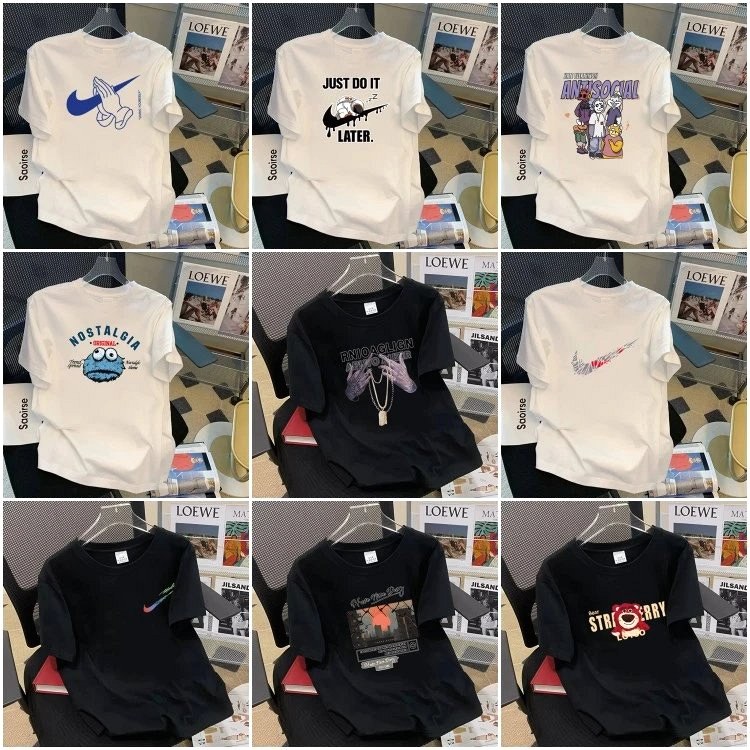
The listing carries 30 print and colour combinations, each offered as a white or black short-sleeve tee, running from swoosh and geometric variants to the sleeping astronaut, motorcycle, city sunset and graffiti motifs. Mechanically the build is as described: crew neck, pullover, short regular sleeve, digital print, stated as breathable, moisture-wicking and colourfast, and labelled for summer and all-season wear.
The problem is the fibre line. The listing names acrylic as the main fabric component and polyester as the fabric name, and nothing in the garment, its label or the QC set resolves the two entries. Our sample behaves like a synthetic blend in the hand: dry, slightly slick, quick to dry on a warm afternoon. If composition matters to you — for skin sensitivity, pilling risk or wash rules — treat it as unconfirmed and have the agent read the garment tag before you commit.
The same caution applies to the name printed on the chest. The listing carries a Nike brand label at 3.88 USD, far below what that label normally costs at retail. We report the brand as the listing states it; that claim is not something a bench scale or a warehouse photo set can verify.
A week of wear, then photographed again
One 30 °C wash, air-dried flat, then worn across a warm week. The print held its edges and colour with no cracking visible in the re-shot, the hem stayed even, and the neckline rib relaxed very slightly — normal for a light synthetic-blend tee on this wash routine. The loose cut is the part that will divide people. It is a genuinely roomy tee, and the complaints we see in category-level fit feedback describe this cut accurately; it is not a fitted tee and it does not pretend to be.
Buyer-written Nike fit reviews say loose-fit tees run roomy and that standard-fit shoppers often size down one. That guidance is category-level and does not cover this listing, so treat it as a starting point and check the chart for the size you intend to wear.
How the score breaks down
- Weight and packing, 5 / 5. 186 g on the bench scale and 214 g bagged — one of the lightest garments we logged this quarter.
- Measurement compliance, 4 / 5. Inside the stated 1–3 cm tolerance on every dimension we checked.
- Print and finish, 4 / 5. Clean digital print and straight construction; the on-surface sheen will not suit everyone.
- Fit as described, 4 / 5. The loose cut is exactly what the listing promises.
- Listing clarity, 4 / 5. A stated tolerance and a full L–5XL run help; the acrylic-or-polyester conflict and the unverifiable brand attribution cost it a point.
That averages to 4.2 / 5 against our five-point scale, where 5 is excellent, 4 good and 3 adequate. On the rolling re-test schedule the tee keeps its shortlist place while it holds that figure; anything that drops below 4.0 comes off our recommendation lists until we test it again.
What works
- 186 g garment weight on our bench scale — among the lightest pieces we logged this quarter
- Thirty print options, each in white or black short-sleeve, in sizes L through 5XL
- Flat-lay matched the chart inside the stated 1–3 cm tolerance, so we raised no measurement flag
Watch-outs
- Listing names acrylic as the main fibre and polyester as the fabric name; the conflict is unresolved
- The loose fit runs roomy, and category-level Nike fit feedback suggests standard-fit shoppers size down one
- A brand name on a sub-4 USD tee is a listing claim our QC photos cannot verify
Buyers filling out a first haul who want a low-cost, low-weight graphic tee in a roomy cut, wear L or above, and will confirm flat measurements with the agent before paying.
Anyone who wants a close, standard fit, or who needs the fibre content fixed before buying. If verified brand attribution matters to you, neither the price nor the QC photos will settle it.
Frequently asked
What does this tee add to a parcel's chargeable weight?
Our size L sample weighed 186 g on a 0.1 g bench scale and 214 g once bagged with its tag. That keeps a single tee's contribution to a consolidated parcel low, which is the main reason it made our first-haul shortlist.
Is the fabric acrylic or polyester?
The listing says both: acrylic as the main component, polyester as the fabric name. Our sample feels like a synthetic blend, but nothing resolves the conflict. Ask the agent to read the garment tag before ordering if composition matters to you.
Does the loose fit run true to size?
It runs roomy, exactly as described. Category-level Nike fit feedback says loose-fit tees fit big and standard-fit shoppers often size down one, but that guidance does not cover this listing. Check the chart for your size instead.