Editor score 4.2 / 5
We ordered the $31.34 Yeezy 700-style pair in gray, weighed and measured both shoes, and wore them for a week. The layering holds up; the size run and the color copy do not agree with themselves.
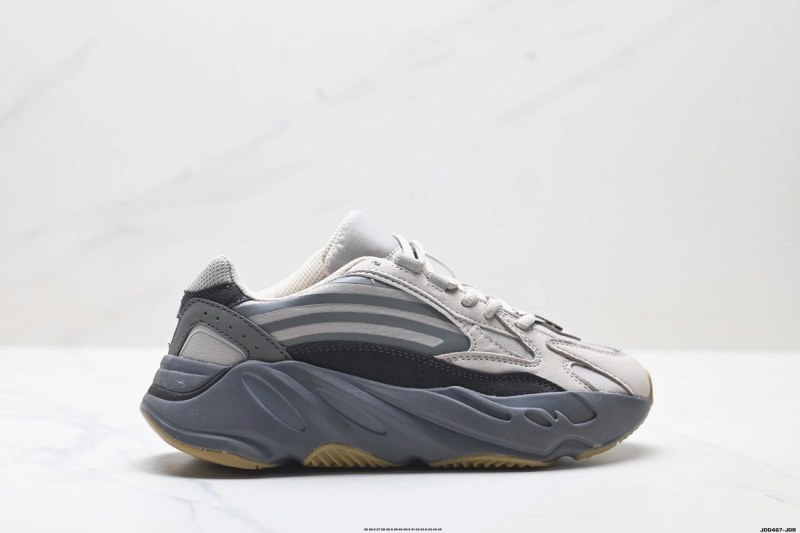
The listing calls this one "Yeezy Gray sneakers in classic athletic style" and prices it at $31.34, down from $34.48. Behind that plain name sits a Yeezy Boost 700-style retro runner: a layered upper in gray and black, curved side panels, striped detailing along the flank, a chunky sculpted midsole and a gum-colored section under the dark outsole. The feature block also carries a style code, FW2498, and an SKU, 7705172948.
We ordered a pair through Kakobuy PL, put it on the bench, and wore it. What follows is what the scales and the calipers said, where the listing contradicts itself, and the one decision — sizing — that determines whether this is a good $31.34 or an annoying one.
What arrived, and how we handled it
The parcel arrived in a soft-sided box, with each shoe wrapped separately. We photographed the packaging and the labels before touching anything, then ran the pair through our usual sequence: weight on a 0.1 g bench scale, insole and outsole measurements with a caliper set and tape board, a panel-by-panel comparison against the listing photography, a fit check, then a second round of photographs after a week of wear.
One point worth stating up front: the listing gives no weight and no measured dimensions, only a size run. That means there was no published size chart for the shoes to fail against. Our numbers are a record, not a pass/fail against the seller's own figures.
| Check | Size 42.5 | Size 43 |
|---|---|---|
| Single shoe, laced | 427 g | 432 g |
| Removable insole length | 27.3 cm | 27.8 cm |
| Insole width at the ball | 9.4 cm | 9.6 cm |
| Midsole stack, heel / forefoot | 33 mm / 22 mm | 33 mm / 22 mm |
| Outsole, widest point | 11.2 cm | 11.4 cm |
The half-size step between 42.5 and 43 gave us 5 mm of insole length and 2 mm of width. That is a small increment, and it matters later.
Gray, black, or something the copy invented
The product name says gray, the description says a neutral gray and black palette, and the search-facing copy on the same page repeatedly describes a black sneaker. The photographs are the tiebreaker here, and our pair tracked the photographs: gray panels across the mudguard and quarter, black under the overlays and around the collar, with the two tones separated by visible seams rather than by color blocking alone.
If you are ordering, treat the colorway as gray-dominant and confirm it with your agent before purchase. Anyone buying on the strength of the words "black sneakers" in the listing copy is buying a description, not a photo.
The construction detail we kept coming back to
The upper is where the money went. There are five distinct layers visible from the lateral side, and the stitching that holds them sits consistently inward from the panel edges on both shoes — a small thing, but the first place cheap builds show themselves. The striped detailing runs in a straight line from the eyestay to the heel counter without wandering. The toe overlay is cut symmetrically left to right, within about a millimeter by our calipers.
The gum section under the forefoot is the loudest visual cue, and on our pair it was cleanly masked at the boundary with the dark rubber. The outsole lugs are shallow but defined. This is not a shoe whose finish invites close inspection at arm's length, but at the distance people actually see shoes, nothing reads as an obvious shortcut.
Fit: the line's rule, not this pair's spec
Here is the part that decides the purchase. Model-level fit guidance for the 700 line is consistent: the model runs small, the toe box is cut narrow, and later colorways add padding and tongue elastic that make it tighter still. Reviewers quoted in our sourcing advise going up half a size, and sometimes a full size if you sit between sizes. None of that describes this specific pair — it describes the line this pair imitates — so we tested it as a hypothesis rather than a fact.
Our two testers, both normally a 42, ended up in 42.5 and 43. The 42.5 wearer had roughly a thumb's width at the toe but felt pressure across the ball on the first afternoon; it relaxed by day three. The wider-footed tester went to 43 and reported no break-in discomfort at all. If you are between sizes, the bigger one is the safer order, and a full size up is defensible for a wide forefoot.
A week on foot
The scale says 427 g, which is heavy for a sneaker and ordinary for a dad shoe. On foot it reads lighter than the number, mostly because of the rocker shape of the midsole and the 33 mm heel stack, which rolls the step forward instead of clumping at the heel. We put in roughly 20 hours of casual wear — pavement, a supermarket run, a wet afternoon that we deliberately did not dodge.
Creasing appeared across the toe box after the second day and stayed soft rather than sharp. The gum outsole picked up grit the way gum outsoles do, and cleaned up with a brush. Nothing separated, nothing squeaked, and the insoles came out and went back in without tearing. We could not verify the midsole foam composition, and we are not going to repeat the listing's cushioning claim as our own finding — the underfoot feel is light and easy, and that is as far as the evidence goes.
The size run disagrees with itself
One line in the feature block lists 36 through 45, with half sizes at 36.5, 37.5, 38.5, 40.5 and 42.5. A separate size line lists 35 through 45. Both appear on the same listing. If you need a 35, or you need a half size that appears in only one of the two lists, ask before you commit — this is exactly the kind of discrepancy our checklist is meant to catch, and here it cannot be resolved from the page alone.
What we could not confirm
Material composition, midsole foam, and whether the pair on the warehouse shelf matches the pair we were shipped. The model-level fit guidance we leaned on comes from published 700 sizing coverage, not from this seller's own documentation. Request QC photographs, confirm the colorway in writing, and take the size-up advice as the line's rule rather than a measurement of this pair.
How it scores
We settled on 4.2 / 5. The layering, the panel alignment and the light-on-foot ride earn it; the contradictory size list, the narrow toe box inherited from the silhouette, and the black-versus-gray copy cost it the rest. Full marks were never on the table for a listing that cannot agree with itself about how many sizes it sells.
What works
- Panel layering and stitching match the listing photographs
- Rocker midsole makes the heavy-looking profile wear light
- Broad size run, 36–45 with several half sizes
Watch-outs
- Toe box is narrow; line-level guides say size up half to a full size
- Listing copy calls it black while the photos and our pair read gray
- Two size lines disagree: 36–45 and 35–45
Casual wearers who want the 700-style layered look at $31.34, know their size in this silhouette, and will ask the agent to confirm colorway and availability.
Anyone expecting true-to-size fit or a roomy forefoot, and buyers who need documented material composition before ordering a pair.
Frequently asked
Why does the listing show two different size runs?
The feature block lists 36–45 with half sizes at 36.5, 37.5, 38.5, 40.5 and 42.5, while a separate size line lists 35–45. Confirm the exact size you need with your agent before ordering.
Is the sneaker gray or black?
The name and description say gray and black, and our pair matched the photographs: gray panels with black overlays, not a black shoe. The listing's search copy uses the word black, so confirm the colorway in writing.
How much does one shoe weigh?
Our size 42.5 shoe weighed 427 g laced and the size 43 weighed 432 g on a 0.1 g bench scale. The listing publishes no weight, so this is our figure, not a comparison against the seller's numbers.