Editor score 4.2 / 5
This guide addresses a specific problem: when you see an erd hoodie or similar style on fashion-reps, how to first verify page evidence, then judge sizing, layering space, and applicable scenarios. After reading, you should be able to complete product page recording, measurement comparison, risk annotation, and decide whether to consult your chosen shopping agent or hold off on ordering. This article does not treat visual impressions as actual try-on tests, nor does it replace the agent's confir
This guide addresses a specific problem: when you see an erd hoodie or similar style on fashion-reps, how to first verify page evidence, then judge sizing, layering space, and applicable scenarios. After reading, you should be able to complete product page recording, measurement comparison, risk annotation, and decide whether to consult your chosen shopping agent or hold off on ordering. This article does not treat visual impressions as actual try-on tests, nor does it replace the agent's confirmation of stock, price, shipping, or after-sale policies. 📌
Verification date: October 21, 2026. Prices, inventory, sizing, product links, agent policies, and logistics fees may change; re-check the page before purchasing.

Defining the Sizing and Usage Scenario Decision for the erd Hoodie
Don't start with "does this piece look good on me," but break the issue into executable checks:
- Does the target size have complete length, chest, shoulder width, and sleeve length data?
- Does the product page clearly indicate color, fabric, fit, and visible details?
- Will the thickness of your inner layer change the required space?
- Do you mainly wear it for long indoor sitting, daily smart-casual office styling, or weekend short trips?
- Which questions must you ask the shopping agent when page information is insufficient?
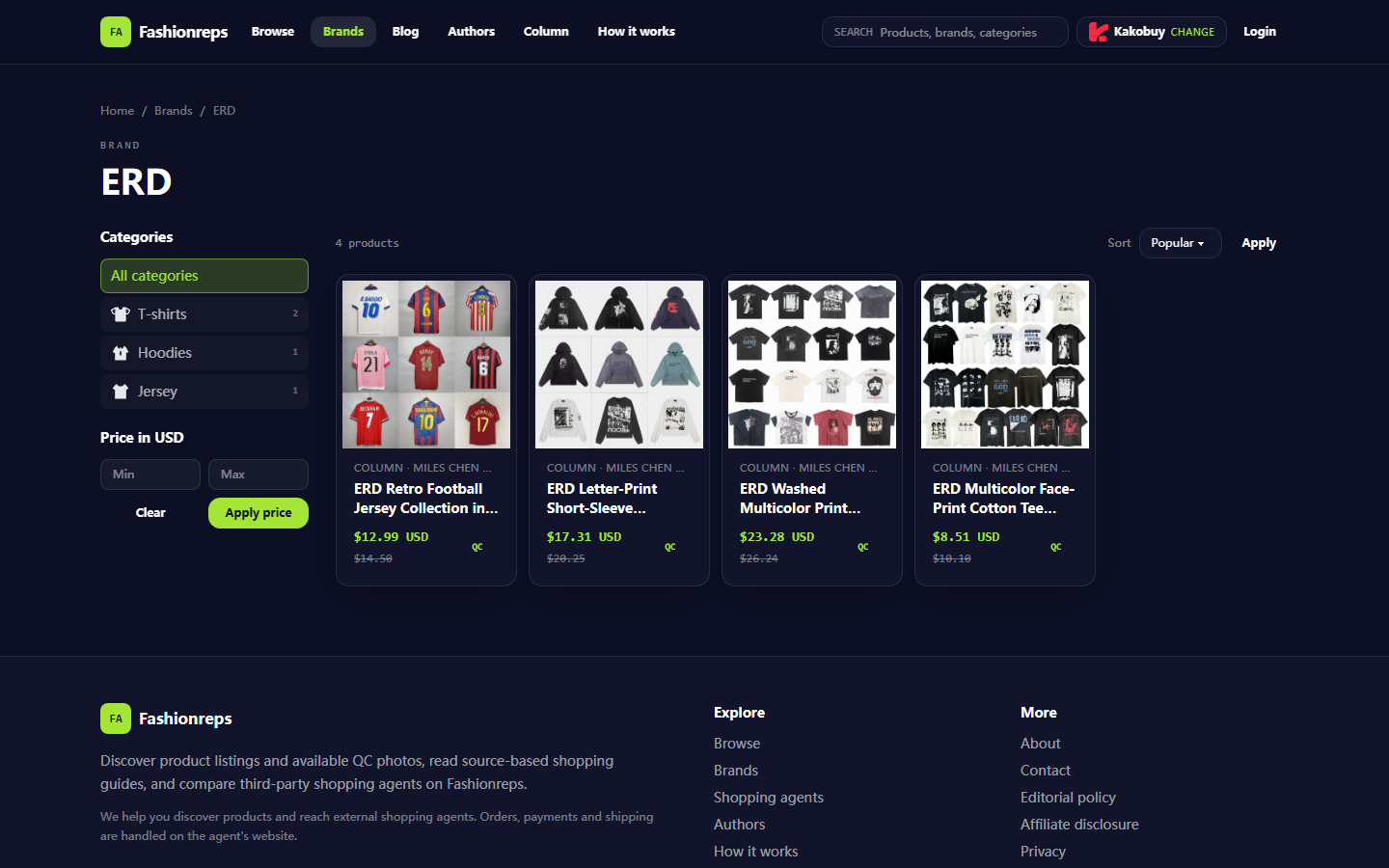
The fashion-reps ERD brand page currently verifiable shows 4 products, with categories including T-shirts, hoodies, and jerseys; but the currently captured product list does not include an erd hoodie size chart, color inventory, or specific product details that can be expanded for confirmation. Therefore, this article will not write unshown sizing, materials, prices, or fits as confirmed facts.
If your goal is to complete a purchase immediately, the safest action right now is to obtain the specific product page and complete measurement chart; if you only see the brand aggregation page or thumbnails, mark the task as pending verification, rather than inferring sizing from the brand name or images.
Recording Color, Size Chart, Length, and Images from the fashionreps Product Page
After opening the specific product page, it is recommended to record in a fixed order to avoid saving only one main image:
- Record the product name, page URL, page display date, and current price.
- Save the color options, distinguishing colors listed on the page from colors that only appear in images.
- Transcribe the size chart item by item, at least including length, chest or half-chest, shoulder width, and sleeve length, and record the units.
- Record whether the page states fabric composition, weight, thickness, lining, or care instructions.
- Save the main image, detail images, and size chart image, while noting whether the images come from the product page or quality check page.
- Check whether the page has stock alerts, out-of-stock alerts, variant selection restrictions, or link errors.
The currently visible information on the ERD brand page includes brand navigation, product categories, reference prices, and website descriptions, but it is insufficient to confirm the specific measurement data of any hoodie. Reference prices cannot automatically be considered checkout prices, nor represent the agent's actual quote. Product pages, shopping agent pages, and final checkout pages may show different shipping fees, service fees, or stock status, and should be checked separately.
For images, focus on recording "what you can see," not "inferring how it will fit." For example, you can note whether the hood has drawstrings, whether the cuffs are obviously narrowed, whether the hem has ribbing, whether the pocket is centrally located on the front panel; you cannot confirm softness, warmth, weight, or post-wash stability from images alone. 🔎
Comparing Page Fields to Determine Fit and Autumn-Winter Layering Space
Layering space for a hoodie cannot be judged by a size letter alone. Compare the product page measurements with your own well-fitting clothing, especially the relationship between chest, shoulder width, sleeve length, and body length.
| Fields to verify | Executable comparison method | Conclusions that cannot be directly drawn |
|---|---|---|
| Chest or half-chest | Measure your frequently worn hoodie flat, then compare with page data | Cannot guarantee freedom of movement from numbers alone |
| Shoulder width | Compare shoulder line position and outerwear shoulder space | Cannot judge overall looseness by itself |
| Body length | Compare with the position you want to cover and outerwear length | Cannot prove it won't ride up when sitting |
| Sleeve length | Compare with your usual inner layer and outerwear sleeve length | Cannot confirm cuff elasticity or layered sleeve effect |
| Fabric and thickness description | Check if page provides composition, weight, or thickness info | Cannot claim heavy, warm, or soft when not stated |
If you plan to wear a long-sleeve T-shirt, thin knit, or thermal layer underneath in autumn/winter, reserve space in the shoulders, chest, and armholes. Size charts only provide static dimensions and cannot replace dynamic movement tests. You can lift your arms, bend your elbows, and sit down to observe whether your old clothing shows shoulder pulling, cuff riding up, or hem bunching, then turn those observations into sizing conditions.
Also pay attention to measurement standards. When the page says "chest," it may mean the garment circumference or the flat half-chest; if the standard is unclear, you cannot directly subtract from your own circumference. When encountering pages with unclear units, measurement positions, or tolerance ranges, consult the agent to confirm first.
Checking Visible Construction of Hood, Cuffs, Hem, Print, and Pockets
Product images can support structure recording but cannot prove quality level. When checking, you can proceed by area:
- Hood: Check whether the hood panel shape, drawstrings, metal parts, or neckline connection are clearly visible in the images.
- Cuffs: Check whether they are ribbed, have obvious tightening, and whether both left and right cuffs are shown.
- Hem: Check whether it is a ribbed hem, straight hem, or other structure.
- Print: Record the pattern position, color, and whether there are close-up detail images; do not write clarity as a durability conclusion.
- Pocket: Confirm whether you can see the pocket opening, opening direction, and approximate position; do not infer capacity from the front image.
- Lining: Only record whether there is fleece or other treatment when the page shows the inside or explicitly states it.
Areas not visible in the images should be marked as "unconfirmed." For example, without an interior image, you cannot confirm whether it is lined; without a close-up print image, you cannot confirm the surface treatment of the pattern; without cuff details, you cannot confirm elasticity or thickness. Recording this way helps avoid mistaking visual judgments for product facts. 🧵
Breaking Down Selection Conditions by Commute, Long Indoor Sitting, and Weekend Outings
Commute scenarios usually require considering outerwear compatibility, sleeve length, and body length. If the hoodie needs to be worn under a jacket, overly large shoulders and sleeves may increase bulk; if worn as an outer layer, you need to additionally confirm the destination weather, wind and rain conditions, and inner layer thickness. When the page does not provide this information, leave it to your personal dressing plan, rather than claiming the product suits all commuting environments.
For long indoor sitting, prioritize checking the neckline, hood, and hem bunching. You can use your old clothing to simulate sitting posture and observe whether the hood easily presses against the back of your neck and whether the hem frequently rides up. This method can only help you assess personal needs, not prove that the erd product itself is comfortable to wear.
For weekend outings, you need to consider the garment volume, pocket structure, washing conditions, and outer layer pairing. If the product page lacks fabric composition or care instructions, you cannot describe it as easy-care or suitable for long-distance carrying. If you plan to purchase cross-border, also separately verify packaging volume, agent service fees, international shipping fees, destination country taxes, and import restrictions. 🚚
Organizing Community Feedback as Leads Without Treating It as Quality Assurance
Community discussions can help you discover questions to ask, such as whether anyone mentions discrepancies between the size chart and actual measurements, whether a certain color is often out of stock, or whether the images may differ from the received version. But community feedback is not the official specification of the product, nor can it replace the current page, agent replies, or quality check photos.
No complete and verifiable community discussion record was provided in this material, so specific user reviews are not cited, and unverified star ratings, popularity, or "real try-on" descriptions are not included in conclusions. If using community content later, read the posts and replies included in the sample completely; if the discussion is deleted, restricted, or only partially readable, mark it clearly as partially read, and do not claim that most buyers endorse a certain fit or quality based on that.
A safer approach is to convert community content into a question list:
- What is the measurement standard of the size chart, and what tolerance exists?
- Does a certain color have independent page images or quality check pictures?
- Are there visible differences in print, cuffs, and hem across different batches?
- Did the buyer's feedback concern page information issues or problems after receiving the actual product?
- Is the feedback timing close enough to the current page status?
Distinguishing Visible Specs, Visual Judgments, and Unconfirmable Wear Experience
To make conclusions reviewable, information can be divided into three layers.
Visible specs are what the page explicitly states, such as product name, displayed price, size chart fields, color options, and public material descriptions. Visual judgments are structure descriptions based on images, such as the position of hood, cuffs, hem, print, or pockets. Unconfirmable experiences include softness, warmth, breathability, post-wash changes, actual weight, freedom of movement, and long-term durability.
Only the first layer is suitable for direct use as product page facts; the second layer needs qualifiers like "image shows" or "judging from visible parts"; the third layer should be written as pending confirmation, and cannot be filled in with definitive tone. Automated content should also honestly state its basis from page fields, images, and public information, and not imply that editors personally purchased, wore, or received the item for testing.
Completing the Sizing, Link, and Evidence Checklist Before Deciding to Consult or Hold Off
Before making a decision, complete the following checklist:
- Obtained the specific product page, not just the brand aggregation page.
- Recorded current color, size, price, and stock alerts, and prepared to re-check before checkout.
- Confirmed the measurement standard and units for chest, shoulder width, body length, and sleeve length.
- Completed flat comparison with your own frequently worn clothing, considering inner layer thickness.
- Separately marked page specs, image judgments, and unconfirmable wear experiences.
- Checked visible details of hood, cuffs, hem, print, and pockets.
- Confirmed the selected shopping agent, service fees, international shipping, destination taxes, import restrictions, and after-sale window.
- Did not treat community feedback, reference prices, or product images as quality assurance.
If you lack the specific product page, size chart, or key images, it is recommended to first consult the shopping agent, asking whether the current link is valid, whether the desired color and size are in stock, the measurement standard, whether quality check photos can be provided, and what handling process applies in case of stockouts or size mismatches. Do not order solely based on brand name, model proportions, or one main image when information is insufficient.
If you ultimately choose combined shipping, it may reduce repeated first-weight or some operational costs, but it may also increase package volume, chargeable weight, single-loss risk, and declaration complexity; split shipping may increase fixed costs, but may be more suitable for route restrictions, value distribution, or different product handling needs. Without current order weight, destination country, route, and quote samples, savings cannot be calculated, and no method can be promised to be cheaper. Before choosing, compare expected savings, added risks, applicable populations, and conditions where the plan is not recommended.
For buyers who need complete sizing evidence, clear layering space, or traceable product images, holding off is usually more appropriate than guessing sizes. For those who have confirmed the page, measurement standard, inventory, and agent policies, the next step is to submit specific inquiries or enter the agent checkout process.