Editor score 4.2 / 5
## Define the Represent Product Link Review Task and Evidence Boundaries The key point of pre-order review is not just saving a product URL, but confirming that the link still points to the correct product, and organizing colors, sizes, image entries, price references, and pending items into a reviewable location. This article compares the site-based Spreadsheet and Google Sheets for this task, based on the [Represent](https://fashion-reps.net/brand/represent) product catalog on fashion-reps. Th
Define the Represent Product Link Review Task and Evidence Boundaries
The key point of pre-order review is not just saving a product URL, but confirming that the link still points to the correct product, and organizing colors, sizes, image entries, price references, and pending items into a reviewable location. This article compares the site-based Spreadsheet and Google Sheets for this task, based on the Represent product catalog on fashion-reps.
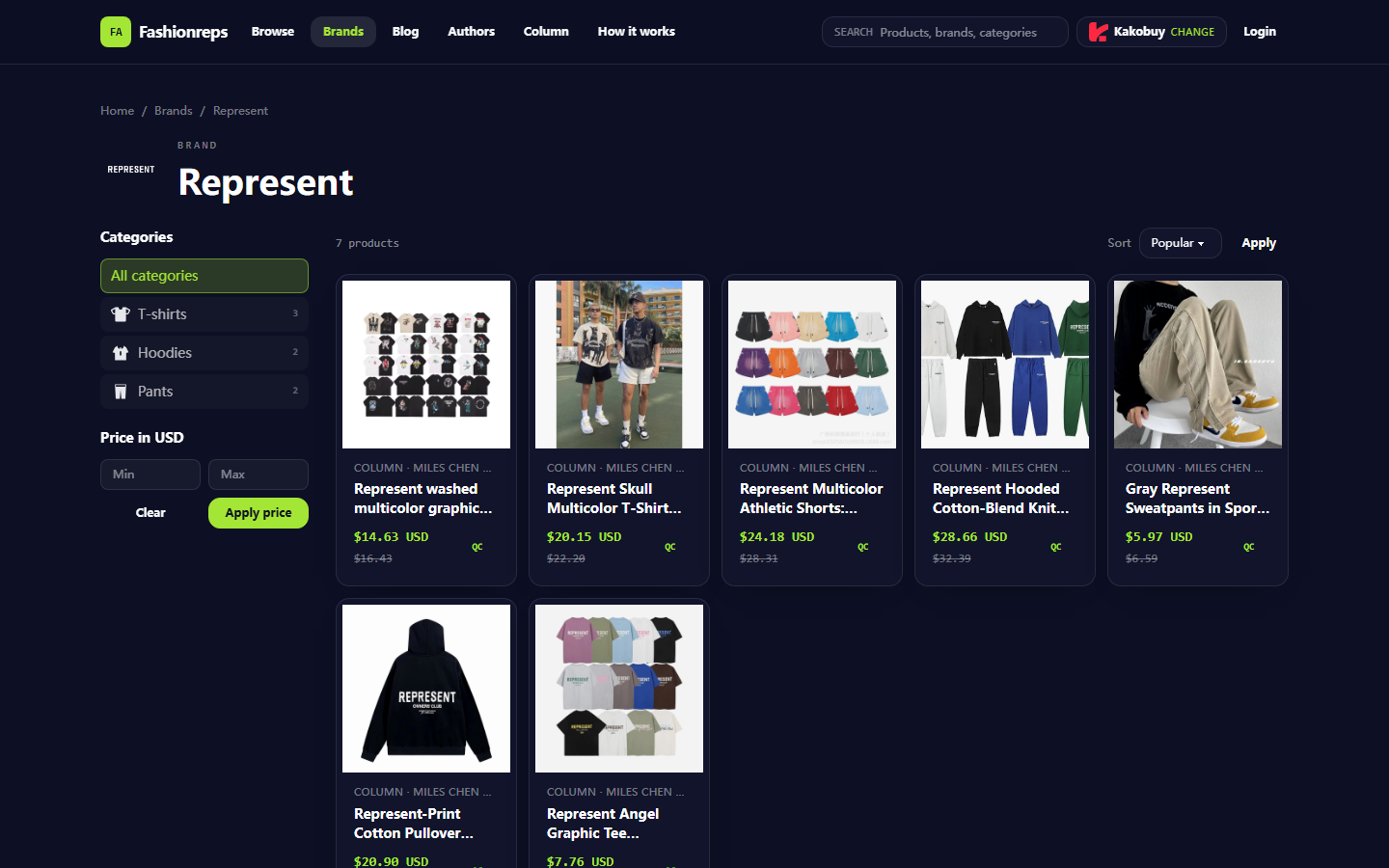
This article is compiled from the Represent brand catalog page on fashion-reps and its visible product card information, with the page verification date of October 13, 2026. The catalog shows 7 Represent products, including T-shirts, hoodies, and pants categories; the page also provides price filtering, sorting, product cards, and QC entry points. Prices, stock, sizes, product links, and external purchasing platform status may change, so you still need to reopen the page to confirm before placing an order. 📌
This review method is suitable for buyers who have already found candidate products and are ready to compare and submit orders. It is not suitable for proving product authenticity, guaranteeing stock, or replacing the final product page, payment page, and after-sales rules on the shopping agent platform.

Verify Product Cards and Links in fashion-reps Site Spreadsheet
The Represent page on fashion-reps first presents a product catalog oriented towards browsing, rather than a blank table that users need to maintain cells themselves. The currently visible page includes the following navigation and filtering information:
- Brand path shows Home / Brands / Represent.
- Categories include T-shirts, Hoodies, and Pants.
- Page shows 7 products.
- Price filtering supports minimum and maximum price input.
- Sorting supports Popular, Latest, Price: low to high, and Price: high to low.
- Each product card contains title, reference price, author tag, and QC entry.
- Page provides shopping agent selection entry; the Buy button will enter the corresponding process according to the selected agent.
These features are suitable for quickly narrowing down candidates, but product cards do not equal a complete order record. The reference price on the card can only serve as a comparative clue displayed on the page at that time, and cannot be directly used as the payment amount. Material, gram weight, color quantity, size range, or style descriptions appearing in the product name should also be verified item by item after entering the product details and shopping agent page.
Record Verifiable Fields from Product Cards
It is recommended to open each candidate product and record the information actually seen on the page, without filling in missing fields based on the title alone. At least keep the following:
- Product title: Copy the title actually displayed on the page.
- Product page URL: Obtain from browser address bar or page button, avoid manual concatenation.
- Brand and category: For example, T-shirt, hoodie, or pants.
- Reference price: Record amount and currency, and mark as reference price rather than final payment price.
- Color: Record colors explicitly listed on the page; if not listed, write "No explicit color information found."
- Size: Record size range displayed on the page; if no size chart, write "To be added."
- QC image entry: Confirm whether the button is visible, can be opened, and whether the images correspond to the current product.
- Update time: Fill in the date and time you actually complete the review.
- Link status: Use clear statuses such as "Accessible," "Redirected," "Page missing," or "Pending review."
- Notes: Record issues such as title-detail inconsistency, image entry failure, missing colors, or price changes.
Such records are more practical than copying a long product description, because they allow you to quickly identify which fields have been confirmed and which fields still cannot support the purchase decision before ordering. 🔎
Use Google Sheets to Create Columns for Link, Specs, Update Time, and Notes
Google Sheets is more suitable for saving review results, rather than replacing fashion-reps catalog navigation. You can create a record table with one row per product, starting with these columns:
| Field | Suggested Filling Method | Review Purpose |
|---|---|---|
| Product Title | Copy page title as is | Avoid confusion with similar styles |
| Product Link | Paste actual page URL | Facilitate reopening |
| Category | T-shirt, Hoodie, or Pants | Filter by category |
| Reference Price | Amount, currency, verification date | Identify price changes |
| Color | Record only colors explicitly shown on page | Check order options |
| Size | Record visible sizes or mark missing | Avoid guessing size by experience |
| QC Image Entry | Accessible, inaccessible, or not seen | Confirm if corresponding evidence exists |
| Link Status | Accessible, redirected, missing, pending review | Manage candidate quality |
| Pending Items | Describe issue in one sentence | Clear item by item before ordering |
| Last Review Time | Date and time | Judge if information is outdated |
You can use filters in the sheet to show only rows with "Pending review" or "Link status not accessible". You can also sort by category, price, or last review time, but do not mistake sorting results for quality ranking.
If multiple people collaborate, Google Sheets' advantage is that you can assign "Pending items" to different people and keep modification history. When involving order numbers, shipping addresses, passports, payment cards, or complete waybills, sensitive information should not be placed in this shared sheet.
Compare Steps for Opening Links and Reviewing Product Information Between the Two Methods
The site-based catalog and Google Sheets solve different problems: the former helps discovery and browsing, the latter helps documentation and review. The safest approach is to use them in tandem, not choose one over the other.
The site-based Spreadsheet or product catalog is suitable for:
- Viewing Represent product collections through brand entry.
- Using category filters to quickly narrow down.
- Discovering candidates through price filtering and sorting.
- Entering details or QC image entry from product cards.
- Continuing to external ordering process after selecting a shopping agent.
Google Sheets is suitable for:
- Saving links and review dates for multiple candidate products.
- Comparing color, size, and QC entry status across products.
- Filtering out products missing size, color, or image evidence.
- Recording page conflicts, redirects, and issues requiring reconfirmation.
- Updating candidate list collaboratively with others.
The recommended practical sequence is: first filter in the fashion-reps catalog, then open candidate products, and finally write the reviewed fields into Google Sheets. This avoids creating a seemingly complete link table that has not been verified through page checks. 🧾
Check Color, Size, QC Image Entry, and Link Status
Color
Colors must be based on visible options on the product page. "Multi-color" or color quantity in the product title does not mean every color is selectable on the current ordering page. If the catalog title, product details, and shopping agent page use different names, record the conflict and use the final selectable options as the basis before ordering.
Size
Do not judge size based solely on fit terms like "loose" or "oversized". You need to confirm whether the page provides size options, size chart, measurement units, and measurement methods. If only ranges like S–XL are provided without specific measurements, mark it as "Missing size chart" in the table, rather than converting it into a recommendation for a certain body type yourself.
QC Image Entry
The existence of a QC entry only means the page provides a viewing entrance; it does not automatically prove that images exist, belong to the current product, or reflect the specific item you will receive. After opening, confirm:
- Whether the image page loads successfully.
- Whether the product in the image matches the title and style.
- Whether the image clearly shows the parts needing verification.
- Whether there are multiple colors or sizes but only one set of unidentifiable images.
- Whether the page requires entering an external platform to see more information.
If it cannot be opened, is empty, or the correspondence cannot be confirmed, record it as pending review.
Link Status
Link review requires at least one actual opening. You can record as follows:
- Accessible: Page loads normally, title and product content correspond.
- Redirected: Automatically jumps to another page, need to confirm if the product after redirect still corresponds.
- Page missing: Shows 404, blank page, or cannot display product information.
- Information conflict: Link accessible, but title, image, specs, or price are inconsistent.
- Pending review: Page temporarily inaccessible, cannot judge that the product has been delisted.
If the page only shows tabs, brand entry, or no clear product name, it should not be saved as a final candidate as a valid product page.
Record Page Missing, Information Conflicts, and Pending Items
Notes in Google Sheets should describe facts and next steps, rather than writing "looks good" or "should be buyable". For example:
- "Catalog card accessible, shopping agent page does not show current color; review color options."
- "Title includes size range, but no specific size chart seen; supplement measurement data before purchase."
- "QC entry visible, but image-color correspondence unclear; hold order."
- "Page reference price has changed; re-record current displayed amount and verification time."
- "After link redirect, product title different; keep original link and request reconfirmation."
For conflicting information, do not directly overwrite old records. Keep the original value, fill in the new value, and note the time of discovery in the remarks. This way, when price or page status changes, you can still see where the change occurred.
Scenarios Where Site Spreadsheet and Google Sheets Are Suitable or Not
The site-based catalog is more suitable for discovering products and browsing context; Google Sheets is more suitable for organizing verified candidate products into a reviewable list. The boundary between the two can be judged as follows:
| Task | More Suitable Method | Reason | Not Applicable |
|---|---|---|---|
| Find candidate products by brand and category | fashion-reps catalog | Page provides brand entry and category filter | When saving multi-person review results is needed |
| Sort by reference price | fashion-reps catalog | Page provides price filter and sorting | When comparing multiple verification prices is needed |
| Save color, size, and notes | Google Sheets | Fields customizable and continuously updateable | When product page not yet opened |
| Track link status | Google Sheets | Can filter pending review records | When trying to replace product detail page |
| View QC image entry | Catalog and product page | Entry linked to product context | When judging product quality solely by entry existence |
| Multi-person collaborative review | Google Sheets | Easy to share, divide tasks, and view modification history | When exposing sensitive order information is needed |
| Final ordering | Shopping agent or seller page | Price, options, and payment process confirmed on external page | When using catalog reference price as payment amount |
It is not recommended to treat Google Sheets as a static link repository. A table without update time, link status, and pending items will quickly become an address collection where you cannot tell new from old. Similarly, relying only on the website catalog is not advisable, because catalog cards may not contain all specifications needed for ordering.
Pre-Order Action Checklist After Completing Review
Before submitting an order, confirm the following items one by one:
- Product title matches the target style.
- Product link can be opened and does not redirect to unrelated product or empty page.
- Color is an actually selectable color on the final ordering page.
- Size and size chart have been viewed; no guessing when missing.
- QC image entry can be opened, or missing situation clearly recorded.
- Reference price has been re-verified against current page, and not treated as final payment amount.
- Shopping agent, shipping, tax, stock, and after-sales conditions have been confirmed on corresponding external pages.
- Last review time, link status, and pending items in Google Sheets have been updated.
- Order, payment, and shipping information has not been written into unnecessary shared sheets.
If colors, sizes, links, or QC image entries still cannot be confirmed, the safest action is to hold the order and keep the pending review status. The site-based catalog helps you discover and enter products, and Google Sheets helps make the review process trackable; only when information from both sides corresponds can a candidate product be suitable for final purchase judgment. ✅