Editor score 4.2 / 5
When returning a rolex watch, the most common mistake is treating the amount on the product page as the final cost. Actual payment and return usually involve different stages: the product itself, agent or handling services, payment fees, packaging and reinforcement, warehousing, international shipping, exchange rates, and potentially applicable tax conditions. Only by recording these items separately can you determine which costs are confirmed and which st
When returning a rolex watch, the most common mistake is treating the amount on the product page as the final cost. Actual payment and return usually involve different stages: the product itself, agent or handling services, payment fees, packaging and reinforcement, warehousing, international shipping, exchange rates, and potentially applicable tax conditions. Only by recording these items separately can you determine which costs are confirmed and which still need to be confirmed after warehousing, weighing, or route selection.

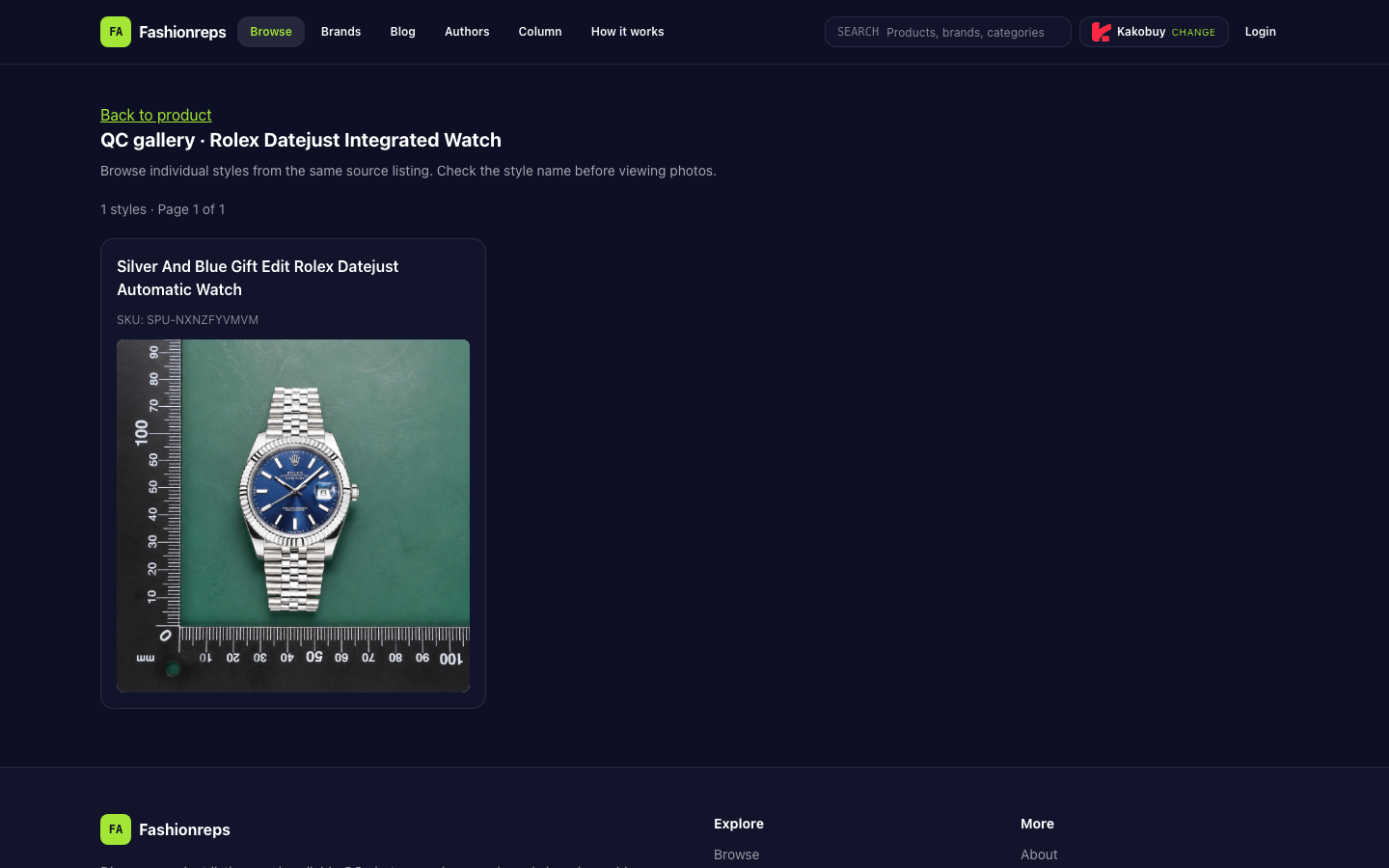
The image above is from the fashion-reps Rolex Datejust Integrated Watch QC page. The displayed model is the Silver And Blue Gift Edit Rolex Datejust Automatic Watch, SKU SPU-NXNZFYVMVM. It can help you confirm the product and model, but the image alone does not prove final price, stock status, international shipping cost, or tax.
First, Confirm Which Product You Are Checking
Before recording amounts, establish the product identity. At minimum, save the following:
- Product name and model name
- SKU or product number
- Color, size, version, and other variant details
- Currency shown on the product page
- Time of page query
- Whether the product page, order page, and QC page refer to the same model
The only product information confirmed in this example is the model name and SKU shown on the page. The available evidence does not provide product price, stock, shipping cost, or tax, so total cost cannot be calculated from it, nor can the page be used as proof of current purchase availability.
If the product name is the same but the variant differs, pause cost aggregation. Changes in color, movement description, accessory combination, or version may alter the order. If the order page does not clearly show the corresponding SKU, confirm with the agent before paying or arranging return.
Break Total Cost into Separate Items
It is recommended to keep the original currency and evidence source for each item, rather than recording only a converted total. The table below is suitable as a pre-return checklist.
| Cost Item | What to Confirm | When It Is Confirmed |
|---|---|---|
| Product amount | Variant, quantity, original currency, any platform discounts | Order page matches product and amount is locked |
| Agent or handling fees | Fees for sourcing, inspection, service, or other platform charges | Fee name and calculation method are clear and appear in order or invoice |
| Payment fees | Payment channel, processing fee, actual debit currency | Payment confirmation page shows final debit amount |
| Packaging and reinforcement | Whether extra boxing, protective material, or special handling is needed | Warehouse confirms packaging plan and cost |
| Warehousing fees | Free storage period, overtime rules, current billing status | Based on warehouse bill or fee details |
| International shipping | Destination, route, carrier method, chargeable weight or volume | Parcel info complete and official quote generated |
| Exchange rate | Settlement currency, exchange time, rate used by payment channel | Based on actual debit or exchange record |
| Tax conditions | Destination rules, declaration info, possible taxes | Conditions are clear; if uncertain, list as unconfirmed |
This table helps prevent double counting and omissions, not to fill in unverified estimates. Without an official quote, keep "To be confirmed"; do not substitute prices from historical parcels, other routes, or other destinations.
Save Evidence at Four Stages
At Order: Confirm Product Amount and Variant
Save the product page and order confirmation page, focusing on model, SKU, quantity, currency, and product amount. If the page shows only a starting price, price range, or unclear variant price, do not treat the displayed text as the final product amount for that order.
Also note any discounts, additional services, or order modifications. Discounts not reflected in the final order cannot be deducted from total cost.
At Warehousing: Confirm Physical Item and Warehouse Status
After the item arrives at the warehouse, save the warehouse record and QC page, and verify the item matches the original order. Record the product name, SKU, number of photos, and any issues found on the page, but do not treat QC images as proof of weight, shipping cost, or authenticity.
If model, color, accessories, or quantity do not match the order, handle returns, replacements, or cancellations before proceeding to international shipping. Continuing to calculate shipping cost at this point may bring the wrong item into the final parcel.
At Weighing: Confirm Billing Basis
Before return, obtain actual weight, parcel dimensions, and chargeable weight after packaging. Actual weight may not equal chargeable weight; if the route charges by volume or the higher of the two, also record length, width, height, and the platform's calculation rules.
The current sources do not provide weight, dimensions, destination, or route for this example, so an international shipping cost cannot be given. Even if the agent shows a shipping estimate, confirm whether it is an official quote or a reference calculation.
At Shipping: Confirm Final Debit and Route
Before paying international shipping, save the final quote page, confirming at least destination, shipping route, chargeable weight, currency, quote validity period, and whether packaging handling fees are included. After payment, save the actual debit record.
If the final debit currency differs from the quote currency, record the quote amount, payment channel exchange rate, fees, and actual account debit separately. Do not keep only the RMB or local currency result, otherwise it will be difficult to tell if the difference is from exchange rate or extra fees.
Keep Exchange Rate Records Separately
Exchange rate is not a number you can fill in arbitrarily later. It is recommended to record:
- Original quote currency and payment currency
- Quote generation time
- Actual payment time
- Exchange rate source used by payment channel or bank card
- Whether a currency conversion fee was charged
- Actual debit amount on the statement
If no actual debit has occurred, do not write a search result or personal common exchange rate as the final cost. You can make an internal budget, but clearly mark it as a budget and do not mix it with confirmed costs.
When to Pause Payment or Shipping
Pause the next step and fill in missing evidence in the following situations:
- The model or SKU on the order page does not match the product page or QC page
- Product amount is only a range or starting price, with no final amount for the variant
- Agent fees, packaging fees, or payment fees have no clear name and amount
- Parcel has not been weighed, or dimension info is missing
- Shipping quote does not specify destination, route, or chargeable weight
- Quote currency differs from actual debit currency, but no exchange rate explanation
- Tax liability and declaration conditions are unclear
- Product status, stock status, or purchase eligibility cannot be confirmed from the current page
Pausing does not necessarily mean canceling the order, but avoiding further irreversible payment or shipping costs when key fields are missing.
Finally, Sum Only Confirmed Amounts
After checking, divide costs into three groups: confirmed, to be confirmed, and potential costs not included in the current total. Use only confirmed amounts in the final total; keep original fields and reasons for missing items in the to-be-confirmed group; list potential taxes or extra handling fees separately, and do not replace them with zero.
For this example, the current source can support the model name, SKU, and QC page as evidence of the product. Since there is no product price, agent fee, payment fee, packaging fee, warehousing fee, parcel weight, destination, international route, exchange rate, or tax conditions, a reliable total cost cannot be calculated. The correct approach is to first archive evidence at the four stages, then sum based on the final order and official shipping quote.